Menu:

JOY

now available from Broadway Play Publishing, Inc.

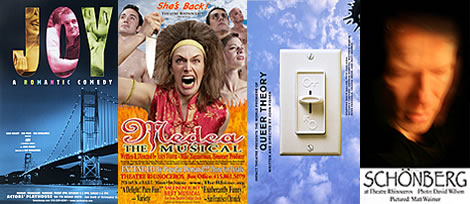
John Fisher has written and directed the following plays:

John Fisher, Playwrite

among others

  Plays by John Fisher

on stage


Special Forces: Summer, 2007

John Fisher's plays have been produced in New York (Off-Broadway), San Francisco, Los Angeles, Seattle, New Haven (Yale) and on HBO as a part of the annual U.S. Comedy Arts Festival.

John is the recipient of the NEA Grant, the GLAAD Media Award for Best Theatre, the L.A. Weekly Award for Best Musical and Best Script, two Will Glickman Playwright Awards for Joy and Medea: The Musical, the BackStage West Garland Award, two Cable Car Awards, a San Francisco Guardian Goldie Award, an S.F. Arts Commission Cultural Equity Grant, a Zellerbach Grant and ten Bay Area Theatre Critics’ Circle Awards.

He received his Ph.D. from U.C. Berkeley in 2001 and has taught at U.C. Berkeley and U.C. Santa Cruz.

CombatCurrenlty John is teaching in the Play Writing program at the Yale School of Drama.

He is currently working on a script about the Mahdi and the Sudan that is funded by a San Francisco Arts Commission Cultural Equity Grant.

Recent directing projects include Red Scare on Sunset for the American Conservatory Theatre’s MFA program and What the Butler Saw for Theatre Rhinoceros.

Recent play writing projects include Richard Burton's Voice at Yale, Special Forces in San Francisco and the up-coming There's Something About Marriage at the 2007 New York Fringe Festival. Special Forces has been adapted as a screenplay.

The Latest

Special Forces (San Francisco: May - July, 2007) is...

"Witty, thought-provoking and inventive... Engrossing and entertaining!" [The Little Man is Clapping!] (Rob Hurwitt, San Francisco Chronicle)

"Low-key hilarity, understated and allusive wit, unexpected grace, and distant but bitter sadness in this canny exploration of war through the prism of gender." (Robert Avila, Bay Guardian)

"Fisher's plays bristle with wit, intelligence, and a wonderfully developed theatrical instinct."
(Steven Winn, San Francisco Chronicle)

"Fisher has talent to burn... Not unlike Tony Kushner, this playwright can set his figures to talking like exclamation-pointed position papers that are both clear and funny."
(Dennis Harvey, Variety)

"A sobering tale of modern combat in which romantic notions of war are trammeled... Special Forces is designed to be lean and mean, much as the current Iraq war was conceived to be. But unlike the war, the play actually succeeds in its terseness."
(Richard Dodds, Bay Area Reporter)

*Special Forces Theatre Rhinoceros, 2926 16th St; 861-5079, www.therhino.org. $15-25. Extended run: Thurs/11-Sat/14, 8pm. "Kuwait City" opens the repertoire of chanteuse Dinah Blue (Matthew Martin), the cool, globe-trotting transvestite whose liaison with a Marine (William J. Brown III) and flirty friendship with his commanding officer (John Fisher) get her entangled in a little scrap called the Iraq War. Her song, in Theater Rhinoceros's world premiere of the latest from playwright-director Fisher (Medea: The Musical, Schoenberg), strikes the principal notes of low-key hilarity, understated and allusive wit, unexpected grace, and distant but bitter sadness in this canny exploration of war through the prism of gender. The play also ironically pays tribute to the Hollywood image of the fighting 1940s in a saving-the-world-from-Private Ryan sort of way, whereby that soldier has morphed into Lt. "Dame" Anderson. This startlingly tough and disturbingly efficient female soldier (powerfully rendered by Helen Sage Howard) leads a rogue special ops mission that Dinah must reach before its misguided objective is carried out. Set on a sparse stage (accented with Jeremy Cole's authentic-looking costumes and blasts from Tanner Menard's viscerally loud soundscape), the production evokes the moral desert of the hardware-strapped US project in Iraq as it intersects (in a way that leaves one pondering) the panorama of gender confusion under a regime of militarism and war. (Robert Avila, Bay Guardian)

Coverage/Reviews of There's Something About Marriage (New York City: August, 2007):

San Francisco Chronicle story, August 10, 2007

"Rhino charges east"

Theatre Rhinoceros is preparing to celebrate its longevity as the nation's oldest "queer" theater company by taking a show to the New York Fringe Festival just before its 30th anniversary season begins. "There's Something About Marriage" - an "irreverent look at the wannabe institutions of same-sex marriage," conceived and directed by Artistic Director John Fisher - plays Aug. 17-22 at New York's Center for Architecture as part of the fringe. Fisher, who also wrote "Marriage" and developed it in workshops at Rhino in the spring, co-stars in the piece with co-author Maryssa Wanlass and actors Sara Moore and A.K. Conrad.
The Rhino's 30th gets under way Sept. 20 with its own look back in celebration, a revue of selections from past work called "Theatre Rhinoceros: The First Thirty Years." Meanwhile, in a kind of cross-country exchange, the theater is playing host to a show arriving fresh from its own well-received off-Broadway run. Plan-B Theatre Company of Salt Lake City opens tonight at the Rhino and runs through Aug. 26 with its production of "Facing East," an original play by Carol Lynn Pearson about upstanding Mormon parents coping with the suicide of their gay son. Tickets at (415) 861-5079, www.therhino.org. - Robert Hurwitt

Reviews:

There’s Something About Marriage
TalkinBroadway Theatre Review by Matthew Murray
There’s Something About Marriage, which is playing at the Center for Architecture as part of the New York International Fringe Festival, is the first show I’ve ever seen to insists its audience members leave their cell phones on - and mean it. In fact, John Fisher, the de facto emcee and Executive Director of San Francisco’s Theatre Rhinoceros (from which this production comes), even offers a prize - “one whole dollar!” - to the first person to receive a call during the show. Gimmicky? Yes. But believe it or not, there is a point: As Fisher explains it, he wants Americans to be a part of the dialogue about gay marriage, and that means keeping all lines of communication open.

The discussion the show encourages, however, is presented as an all-out burlesque. Conceiver-director Fisher, A.K. Conrad, Sara Moore, and Maryssa Wanlass enact a dozen or so fast-paced skits focusing on topics of vital interest to San Franciscans and Americans in general. Among them: Mayor Gavin Newsom’s 2004 same-sex marriage initiative, scenes from the lives of two couples (one male, one female) pondering the meaning of love and commitment in their own lives, the extent to which President Bush was reelected because of a gay-marriage backlash, and even parodic game shows aimed at identifying in-the-closet straights, unveiling lesbians’s sexual habits, and determining the degree to which homosexual self-loathing is lied about.

Despite being coated with a crude shallowness - which reaches its nadir (or, depending on your point of view, its zenith) in two gay porn clips for which the audience is encouraged to provide the soundtracks - There’s Something About Marriage is a compellingly complex look at an oversimplified subject. Its interweaving of political and social concerns is deceptively sophisticated, and its messages are hardly of the sound-bite variety. If you’re expecting this show to be either an inveterate drum-beater for gay marriage or to firmly denounce it, you’ll be disappointed: The show collects more diverse opinions and attitudes about the subject than you’ll find in most news accounts or editorials.

Even if they’re wrapped in a satiric package, you’re forced to take them seriously. As There’s Something About Marriage examines so many facets of this struggle for equality, you might just find yourself stunned at the fresh understanding you take away from a subject that often seems to have been discussed to completion.

BACKSTAGE.com Review
There's Something About Marriage
August 20, 2007
By Paul Menard
San Francisco's legendary Theatre Rhinoceros has invaded New York and wants to know what you think about same-sex marriage. Its audience-goading Fringe Festival entry, There's Something About Marriage, hopes to illustrate that this frequently oversimplified issue may be more complicated than either side is willing to admit.

A faux seminar about "gay empowerment" composed of improvisation, short skits, and game-show antics, There's Something About Marriage aims to keep audiences off kilter. Whether through the highly personal questionnaire with yes or no the only possible responses to outlandish sexual questions or the screening of hardcore gay porn for which the audience is asked to provide the soundtrack, the show tries to rattle audiences into confronting dichotomies, stereotypes, and facile thinking.

But don't expect the Rhinoceros gang to provide answers or confront the issue of marriage equality itself. Instead, the piece bluntly criticizes the political strategies and social brouhaha surrounding the debate.

NewYorkTheatre.com Review
There's Something About Marriage
Reviewed by Debbie Hoodiman Beaudin
Aug 17, 2007

Theatre can be an excellent forum for exploration of current issues, and Theatre Rhinoceros's show There's Something About Marriage invites the audience to "join the debate" on the issue of same-sex marriage. In this raunchy, sometimes satirical, sometimes political, very silly, show, San Francisco's oldest gay theater company creates a sort of collage of thoughts about gay sexuality and the issue of same-sex marriage.

Structurally, the show is broken up into a few throughlines woven together. One throughline consists of audience participation, led mainly by John Fisher (who also directs and created the show) and sometimes by Maryssa Wanlass. In the segments where Fisher and Wanlass talk directly to the audience, some of the dialogue comes from a dirty audience survey given out at the beginning of the show, and knowing I might get to talk to the actors (or win a prize!) certainly felt exciting. The purpose is to get the audience warmed-up, loosened-up, and involved, not to find out what we think.

There is also a story line exploring the dating history of two same-sex couples (one female, one male) who meet online. This throughline was interesting because it showed how we can think we know what we want in a partner yet be completely wrong about what we need. It's also interesting that the two couples end up having different views about whether they want to get married at all, showing a diversity of opinions, which helps to balance the show. In the story lines of the two couples, I enjoyed the acting by the company, particularly A.K. Conrad's ditzy, pop-culture-obsessed, flirtatious boy and Sara Moore's Midwestern, sort-of dorky, totally sincere character.

There is also a satirical bit about Gavin Newsom (played with appropriate broadness by Conrad), who legalized gay marriage in San Francisco in 2004. The sequences about Newsom make fun of him in a way that is true to sketch comedy, and explore the actual history of what happened. I enjoyed these sequences because they gave information about the politics of the issue and how sometimes controversial issues can galvanize not only those who want change but also those against the issue.

Worked into the live sequences is video, some of which is explicit. One video, credited to David Mahr, is a montage of same-sex weddings, while Mahr's song, "Stop the Gays," plays. The video has a documentary feeling, and the song, which is not completely pro-same-sex marriage, coupled with the video, again, gives the show diversity of opinion.

Theatre Rhinoceros: The First Thirty Years

Conceived and Directed by John Fisher

Opened September 20

Extended to October 21!

Reviews:

San Jose Mercury News

By Karen D'Souza

"San Francisco’s Theatre Rhino may be as piercing as ever. The nation’s longest running professional queer theater is celebrating 30 years of “the love that not only speaks but also shouts, sings and dances its name.’’ Director John Fisher, best known for the phenomenally smart and funny postmodern-disco fable “Medea: the Musical,’’ has extended the company’s anniversary show “Theatre Rhinoceros: The First Thirty Years” through Oct. 21. The tuneful retrospective slices into three decades of cutting-edge comedy, sex and politics. This is musical comedy so sharp it stings."

SF Bay Times

By Sister Dana Van Iquity

"The whole sensational show ends with a catchy cast number, “The Rhino”...  Don’t you dare wait for the next ten years of retrospective; see Thirty Years now!!!"

SF Bay Guardian

By Robert Avila

"Gay times: Celebrating the Rhino's three transformative decades of transgression"

"A series of slide projections cycling through a gamut of theater posters greets audiences taking their seats at Theatre Rhinoceros's 30th season opener. Ranging in design from the openly trashy to the quietly tony, many of these posters offer eye-catching portions of skin and equally intriguing titles: Cocksucker: A Love Story, Deporting the Divas, Pogey Bait, Show Ho, Intimate Details, Barebacking, and Hillbillies on the Moon. It adds up to a hefty if scantily clad body of work that owes its existence to a good extent to the advent of Theatre Rhinoceros. Begun in 1977 by Alan Estes in a SoMa leather bar with a production of Doric Wilson's The West Street Gang, the Rhino today is the longest-running LGBT theater in the country.

Thirty years like these call for a moment of reflection, and the Rhino's lasts a brisk and enjoyable 70 minutes. Conceived and directed by John Fisher, who became artistic director in 2002, Theatre Rhinoceros: The First Thirty Years takes a jaunty look back at a raucous, at times traumatic, but overall remarkable theatrical career intimately tied to the social and political history of the queer community. While making no attempt to be exhaustive, or exhausting, Fisher's swift, celebratory pastiche (with dramaturgy by actor and associate artistic director Matt Weimer) neatly suggests the range of artistic output and the sweep of events and personalities that have gone into defining the theater and its times.

The bulk of the show comprises a choice selection of scenes and songs from productions past (with some original compositions and arrangements by Don Seaver and snazzy choreography by Angeline Young), put on by a capable five-person ensemble, all but one veterans of previous Rhino shows. Sporadically introduced by Fisher — who as MC strikes the right note at once, with a deadpan motorized entrance onto a stage decked out (by designer John Lowe) in a shimmering red glitter curtain worthy of Cher or Merv Griffin — the selections progress more or less chronologically, though the cast leads off with a rendition of "Dirty Dreams of a Clean-Cut Kid," from the musical of the same name by lyricist Henry Mach and composer Paul Katz, which was a hit for the Rhino in 1990. It's an apt piece to introduce part one of the show, "Coming Out/Living Out," the first of four sections charting the development of the theater and its audience.

Other highlights include a scene from Theresa Carilli's Dolores Street, an early lesbian-themed play that marked the Rhino's (at the time somewhat controversial) turn to more inclusive queer programming. It's a still tart and funny comedy about the relationships in a young lesbian household in San Francisco, at least judging by the scene expertly reproduced by Laurie Bushman and Alice Pencavel.

The live sequences come interspersed with videotaped interviews of Rhino founders and associates, including Lanny Baugniet, P.A. Cooley, Donna Davis, and Tom Ammiano. The cast also reads excerpts from letters to the theater from subscribers and some well-known playwrights, most offering praise and thanks, others caviling at the quality of a specific production, expressing indignation over liberties taken with a script, or offering resistance to the changes in programming that opened the stage to lesbian themes and, eventually, many other queer voices. (It's indicative of how far things have come that a letter like this last one, which pointed to once serious divisions in the larger gay community, elicited only comfortable laughter from the opening night's audience.)

In part two, "AIDS," the ensemble re-creates highlights from the Rhino's historic long-running revue, The AIDS Show: Artists Involved with Death and Survival. A collaborative venture between 20 Bay Area artists and an unprecedented, defiantly upbeat response to the terrifying onset of the AIDS crisis, the show took aim at the still largely repressed issue of safe sex through such numbers as Karl Brown and Matthew McQueen's cheeky sizzler "Rimmin' at the Baths" and their equally clever and forthright "Safe Livin' in Dangerous Times" (both beautifully rendered by the full cast of Theatre Rhinoceros), as well as the terrible toll in drastically foreshortened lives (seen here from the perspective of a mother, affectingly played by Bushman, in Adele Prandini's "Momma's Boy"). The AIDS Show, which went on to tour the country and put the Rhino on the national map, premiered to packed houses in 1984, the year its creator and Rhino founder Estes died of the disease.

This show's parts three and four deal with the growing diversity of voices and issues in the years of relative liberation and mainstream exposure for the LGBT population. A scene from Brad Erickson's Sexual Irregularities (played by Weimer and Kim Larsen) broaches the conflict between homosexuality and religion, a theme increasingly explored in new work for the stage, while one from Guillermo Reyes's Deporting the Divas (played by Larsen and Mike Vega) points to the increasing presence of minority voices, reporting on the gay experience from the perspectives of particular ethnic subcultures.

In the postmodern micropolitics of sexual identity characteristic of the new millennium (and spoofed hilariously by Weimer, Larsen, and Vega in a scene from Fisher's Barebacking), queer theater is characterized by increasingly hybrid categories and a plethora of voices from all sectors of experience. The cast sums up the road thus far with a characteristically proud and wry glance at the possibilities ahead in the show's final, original number, "The Rhino" (by Seaver, with lyrics by Weimer). But, to invoke an older song, anything goes."

Bay Area Reporter

"Turning 30: Theatre Rhino revue looks back"
Published 09/27/2007

By Richard Dodds

"There's something Peter Pan-ish about Theatre Rhinoceros, which has grown old without exactly growing up. In Theatre Rhinoceros: The First 30 Years, a revue that pays tribute to three decades of queer theater-making, current executive director John Fisher, the new show's conceiver and director, tells us that the very first show was a happening titled Gayhem, before the cast breaks into characters to suggest what it might have looked like. The new show in which it's included has a gayhem attitude toward trying to sum up 30 years in under 90 minutes.

That's a good thing, because the task is so improbable that the light and loose spirit at hand is likely required. Fisher, who arrives on stage on a motorized scooter, acts as narrator, using notes to provide names, dates, and details, but mostly maintains a conversational, often self-deprecating tone with the audience. The cast of five will offer "a taste, a sampling," he says, of past productions, with the proviso that only works that were written for Rhino will be included. It's a smart choice, providing a necessary limitation, and also surprising us with material that has gone unseen for years.

San Francisco Chronicle

"Don't Miss: 'Theatre Rhinoceros: The First Thirty Years'"
Stephanie Laemoa
Thursday, September 20, 2007

"Theatre Rhinoceros opened its doors to the public in 1977 and has since become one of the pre-eminent queer theaters in the nation. Conceived and directed by John Fisher, this production is a trip down memory lane, with original songs and scenes reminiscent of three decades of this company's particular take on sex, politics, fun and everything in between."

Previews:

San Francisco Chronicle

Pink Section Article

By Rob Hurwitt

Sunday, September 23, 2007

"Theatre Rhinoceros celebrates 30 years of gay and lesbian plays"
"Given another decade, it may have to start lying about its age. Theatre Rhinoceros, San Francisco and the nation's "longest-running professional queer theater company," turns 30 this season. Founded in 1977 by Allan Estes, its first artistic director, and managing director Lanny Baugniet, the Rhino has long enjoyed a higher national than local profile as an incubator of new gay and lesbian plays, becoming the first gay theater to receive National Endowment for the Arts funding.

It's celebrating with a look back, "Theatre Rhinoceros: The First Thirty Years." Compiled and staged by current Artistic Director John Fisher, the show is billed as a revue of "original songs and scenes from three decades of new theater about the love that not only speaks but also shouts, sings and dances its name."

There's a lot to celebrate, not the least of which is the Rhino's survival. It's had to weather more than the usual share of small arts institutions' financial challenges and growing pains - including the cooptation of its special niche, as gay, lesbian and transgender themes have found homes in mainstream theater, films and TV.

The AIDS pandemic took an exceptionally heavy toll among the company's artists, including three Rhino artistic directors: Estes, who sickened and died suddenly in 1984 at the age of 29; Chuck Solomon, who ran its Playwrights Workshop; and Kenneth Dixon, one of the first African Americans to run a non-ethnically defined theater. Dixon's tenure in the late '80s saw the company struggle to broaden its ethnic inclusiveness, wrestling with internal and external issues of racism in the gay community and homophobia in ethnic communities. In some respects, that struggle was civil compared with the one that preceded it - when Estes, not long before his death, began including lesbians in what had been an exclusively gay male company.

"Now we take this stuff for granted," says Adele Prandini, one of the first lesbian playwrights at the Rhino and later its artistic director. "The male-female thing is no big deal anymore. But back then it was, definitely. There was a lot of mistrust from the lesbian community toward the gay men's community and vice versa."

Prandini came into the theater in 1984 for the staging of her play "A Safe Light" and soon found herself involved in the collaborative creation of "The AIDS Show" - originally called "Artists Involved in Death and Survival" - a project conceived by Estes and brought to fruition by director Leland Moss. In a short time, Prandini became an integral part of the Rhino, serving as its production manager for most of the '80s, alongside another "AIDS Show" recruit, popular playwright-performer Doug Holsclaw ("Life of the Party," "Don't Make Me Say Things That Will Hurt You"), who served as her associate artistic director through most of the '90s and succeeded her at the helm.

"It was an organization in trauma," Prandini observes of her first years. "Everyone was getting sick and nobody knew why. And people knew that once you got sick, you didn't have much time to live - so many people, such a waterfall of illness and death.

"At the same time, Allan started taking the first steps of turning the Rhino from a gay men's theater into a lesbian and gay theater. Then Kris Gannon (who succeeded Estes as artistic director) brought that more into being with her leadership. So we were dealing with a community under terrible stress and learning how to work together, trying to make the organization run successfully and be artistically smart. ... I feel I grew up as a human alongside Doug."

The Rhino was also beginning to get some national attention. It had attracted a growing local audience with such shows as Doric Wilson's "West Street Gang," moving from one location to another before settling in its 16th Street home. As much as it built on the popularity of recognizable names like Lanford Wilson, Harvey Fierstein and Robert Patrick, the Rhino had always been dedicated to presenting new works, many by local gay writers such as Robert Chesley, C.D. Arnold, Philip Real and Dan Curzon.

"The AIDS Show" put Rhino on the map. The collection of scenes and songs gained widespread attention as the first theatrical response to the pandemic, touring throughout the country. A second "AIDS Show" in 1985, with new songs and scenes, became the subject of a PBS documentary by Rob Epstein and Peter Adair.

"The very nature of the company, as a sort of loose collective, allowed for the earliest response to the AIDS crisis," Fisher says. "It didn't have to wait for a playwright to sit down for six months to write a play. It could have 20 artists create 20 scenes and songs and almost overnight have something like 'The AIDS Show.' "

Holsclaw, who was one of the creators, remembers that it wasn't easy to get everyone on the same page.

"People forget that the gay community was very divided in the early days of AIDS," he says. "A lot of people were saying, 'This is not happening,' or 'This is a plot by the Republicans to try to control our sex lives.' There were all kinds of conspiracy theories. To me, none of that mattered. We needed to protect ourselves. So I was one of the early safe-sex Goody Two-Shoes. That was my message. ... You know, we had no idea where AIDS was going, but that is how people deal with fear. Some people gain weight. I write a play.

"In the early days, people were hungry for information and a community setting in which to express their emotions. That turned pretty quickly. After seeing enough friends die, they didn't want to see anything more about AIDS. Then came the nudie thing in gay theater."

But not only nudity. As Fisher points out, Rhino was creating "important new work on important queer themes, a lot of shows on subjects that hadn't been addressed yet in mainstream theater. 'The Cradle and All' was an early lesbian play about having babies. George Birimisa's 'Pogey Bait' was about gays in the military, in 1982, long before people were doing shows on this. Brad Erickson did a play about homosexuality and Catholicism in the '80s. The most exciting thing about this theater for me has always been the new work. The Rhino was dedicated to the vision of gay, lesbian, transgender, the whole BLT panoply long before it was hip."

"That's the thing about queer theater," Holsclaw says. "It's defined not by its aesthetic but by its subject matter. So we tried to explore. My years there with Adele, we both wanted to do new work. ... We were creating a body of literature that did not exist before and telling truths that hadn't been said out loud before. And we didn't care what straight people thought. That was our mantra: We're not here for straight approval. ... What we didn't want were plays with a couch onstage: The guy comes in and says, 'Mom, I'm gay,' and she cries, 'Oh, we didn't play enough football.' "

That's the legacy Fisher is celebrating in the season opener, with material from "The AIDS Show," the Five Lesbian Brothers' "Hillbillies on the Moon" and works by Prandini, Doric Wilson, Erickson, Cherrie Moraga and others. "Thirty Years" can't possibly be inclusive, but Fisher says it provides "thumbnail sketches" that break the Rhino's history into four periods: coming out, AIDS, diversity and the new millennium. The season will continue with a still unconfirmed second show (probably a revival of Mart Crowley's long controversial play, "The Boys in the Band"), an annual New Year's Eve appearance by the ever-popular Marga Gomez and the local premiere of David Mamet's elusive and intriguing lesbian play, "Boston Marriage." It closes in late spring with the world premiere of Fisher's newest creation, "Ishi: The Last of the Yahi."

For now, the focus is on a 30-year legacy of new work.

"That's its greatest contribution, this plethora of new plays," Fisher says. "Maybe they haven't gone on to become Pulitzer Prize winners, but I think these are the plays that informed the work of the ones that became famous."

"There's a level on which we accomplished what we set out to do," Prandini agrees. "Other folks are more than happy to do lesbian and gay, transgender material now. The Rhino played a part in expanding those boundaries."

As Fisher sees it, the mainstream media's newfound comfort with gay themes opens up new worlds for the Rhino.

"Our role is changing," he says. "I think it's broadening, locating the homosexual in a more assimilated society. We've got liberation. Now we want rights. So the battle is around marriage and the rights every other citizen has - for gay men, for lesbians, for transgenders, for anybody who has made a choice or been born in a way that is differentiated from the 'norm.'

"We're like the Mime Troupe, in that the problems are always there. The struggle is to find those problems and address them, not just settle for entertainment. There are plenty of gay entertainments out there. We have to remain politically engaged."

Staircase

By Charles Dyer

Directed by John Fisher

November 17 to December 16, 2007

Reviews:

Bay Area Reporter

"Tres gay lovers, 'Staircase' revived at Theatre Rhino"
Published 11/29/2007

By Richard Dodds

Staircase, Charles Dyer's 1966 play about a pair of aging gay lovers, is more remembered for how it was handled, on Broadway and by Hollywood, than for what it had to say in that awkward age just before homosexuality had forced itself into the brewing cultural revolutions. Free of the baggage it accumulated when it was new, Staircase gets a rare staging at Theatre Rhino, where the play is intriguing as much for the cultural artifacts it reveals as for its wavering theatrical impact.

Dyer, a journeyman British playwright, scored his biggest hit when the Royal Shakespeare Company produced Staircase in 1966 with Paul Scofield and Patrick Magee as partners in life and a barbershop in Brixton (realistically rendered in Jon Wei-keung Lowe's set). Charlie and Harry's 30-year-old relationship now seems built on insults, nagging, and revisited disappointments, all of which are exacerbated by Charlie's pending court date for donning drag at a neighborhood pub. "This will ruin my comeback," says Charlie, a one-time actor most famous for an old television commercial. The long-suffering Harry mostly puts up with his partner's idiosyncrasies, though in the course of the intermissionless two-hour play, conflicts rise to a boil before returning to a simmering resignation with, perhaps, a trace of contentment.

Staircase was presented on Broadway in 1968 as a commercial offering with Milo O'Shea and Eli Wallach as Harry and Charlie. In their Playbill bios, as noted by William Goldman in his book The Season, all the main creative people stressed their heterosexual credentials. Despite some good reviews, it quickly closed. "Staircase was dead the minute they decided to style the production," Goldman wrote, "as if it were a charade performed by happily married daddies."

A film version the following year seemed to enhance the charade, as Rex Harrison and Richard Burton took on the roles of Charlie and Harry. It seemed to please no one, but some of its rejection clearly came from a homophobia that critics still felt free to express. "Like homosexuality, which confuses one love object for another," wrote Vincent Canby in The New York Times, "the film is full of grotesque substitutes, false teeth, false hair, feminine pronouns for masculine."

Which brings us up to today and Theatre Rhino, where no one is likely to defensively inject testosterone into his program bio. Nor must mincing be subdued in service of PC gay reformation. As Charlie, the has-been actor and accused corruptor of public decency, Donald Currie throws himself into the role of a preening queen whose main torment is an internalized homophobia. He periodically trots out the fact that he was briefly married and sired a child. "Nothing puffy about me, mate," he tells Harry. "I'm normal."

Harry, on the other hand, seems more accepting of his fate, at least as far as his sexual orientation is concerned. He even dreams of a day when gay couples can adopt children. But he is devastated by the alopecia that has suddenly rendered him bald, and wears surgical bandages to hide his shame. Joseph Tally plays Harry with gentle empathy that provides an endearing contrast with his partner's histrionics.

Overall, this is a small story in both its comedy and drama, though it has been directed with a good deal of flamboyance by John Fisher. After all these years, the main lure of Staircase seems not so much in what it has to say or how it says it, but in the knowledge of when it was saying these things.